Margin can beat attendance.
A smaller crowd can contribute more profit. Savings on real incremental costs strengthen that case.
Supply & demand / 供需实验室
A stadium can be one-third full and still be charging its most profitable price. The missing crowd is not, by itself, missing profit.
满座不等于利润最大化。关键不是最后一个人付多少钱,而是为了让他进场,其他收入会损失多少。
Take control of the ticket price ↓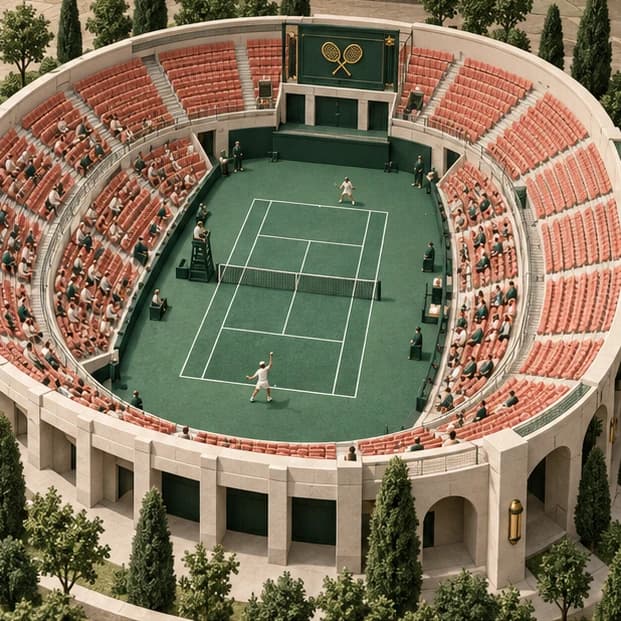
The short answer
A smaller crowd can contribute more profit. Savings on real incremental costs strengthen that case.
A uniform price cut attracts new buyers but also earns less from buyers who already wanted to come.
Less wear may save cash. A high ticket list price alone does not hold up the stadium’s carrying amount.
Price versus capacity / 价格与容量
“There is spare supply, so price should fall” describes a pressure, not a guarantee of a sellout. A stadium’s capacity is a ceiling. The seller of a differentiated event faces a downward-sloping demand curve and may earn more by serving only part of it. Other matches, streaming, and staying home still compete for the same evening. [1]
Before sales begin, compare two whole pricing policies—not an expensive ticket already sold with an extra cheap ticket added for free. Profit rises only when the extra contribution exceeds the revenue sacrificed elsewhere. Try the price slider, then remove crowd costs entirely.
Illustrative model, not venue data. The starting $60 extra cost per attendee is chosen to make one-third occupancy optimal—not estimated from cleaning or wear. Use “No crowd costs” to isolate pricing alone.
● Coral: your price · ○ Green ring: profit-maximizing price. Curves use your selected assumptions.
You set the price / 你来定价
Best under these assumptions: $120 · 33.3% full · $0.30m profit.
The first block is covered by fixed costs. Another block opens only when demand crosses its threshold. Fixed costs are already committed; cancellation is outside this experiment.
The next price cut
You gain 1,667 expected buyers. But in this before-sales, uniform-price comparison, all 10,000 existing buyers also pay less.
One event; 30,000 interchangeable seats; one uniform price chosen before sales; all buyers attend. Demand is Q = min(30,000, M × (1 − P / 180)), bounded below by zero. Profit = (P + A − C) × Q − fixed costs − extra block costs. Dollar amounts are illustrative. The $60 starting crowd cost is deliberately chosen to produce one-third occupancy; it is not an estimate of stadium cleaning costs.
Without capacity limits or tier costs, the interior optimum is P* = (180 + C − A) / 2. Fixed costs shift the profit curve vertically but do not move this optimum. The optimizer also checks capacity and tier boundaries. No-shows, differentiated seats, uncertainty, repeated purchases, and taxes are omitted.
The starting inputs are chosen to make the optimum one-third full. That fraction is not an economic law. With zero crowd costs, the same linear-demand model peaks at half capacity. With a smaller potential audience, even free admission may leave seats empty. Travel time, scheduling, interest, and transport remain costs to the fan.
Your operating-cost theory / 你的成本假说
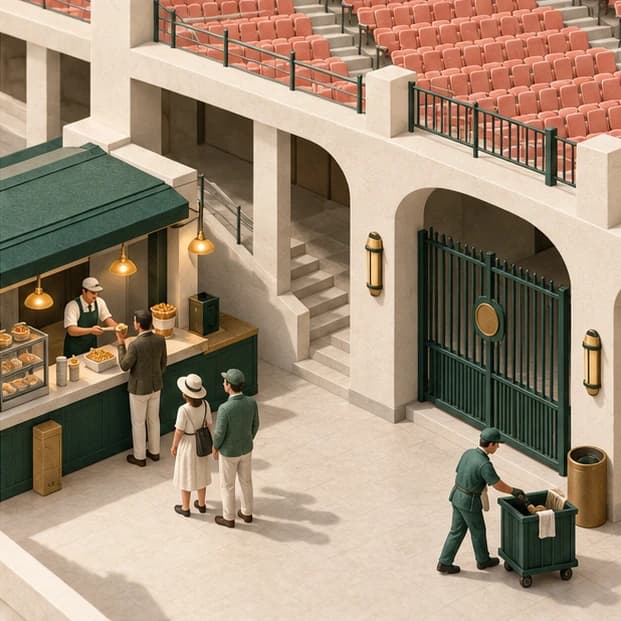
Your intuition is sound when fewer attendees actually avoid costs: waste handling, consumables, usage-related damage, or an additional staffed concourse. If another tier must open for a small number of extra buyers, that discrete cost can outweigh their tickets.
But building depreciation, the performer’s guarantee, and a baseline event crew do not necessarily disappear when a seat stays empty. Dividing all of those costs by attendance gives an average cost; it does not tell you what one extra customer costs. In the main lab, raising the fixed event cost changes total profit, not the best price.
Food, parking and merchandise can make an additional fan valuable even on a cheap ticket. Count the seller’s net incremental share, not gross concession sales. Sports-economics research explicitly studies this complementarity. [2]
A lively crowd can also improve the experience and future demand. That is a plausible additional benefit, not a measured dollar amount in this model. Public operators may value access and community participation as well as financial returns.
The last-seat objection / 为什么不单独打折?
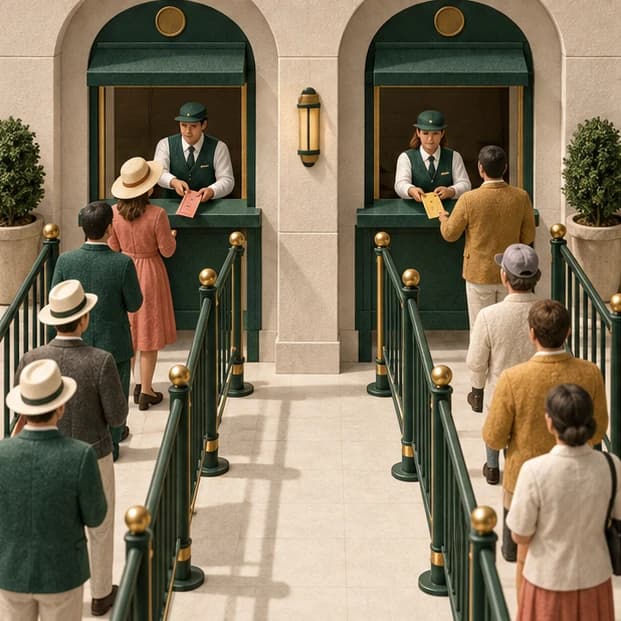
Often, that is exactly the right move. Once prior sales are locked in, an extra ticket does not mechanically reprice them. With no displaced future buyer, no extra tier to open, and no harm to later sales, sell the spare seat when its ticket plus ancillary contribution exceeds its incremental cost.
The difficult part is maintaining that separation. If regular buyers learn to wait for a public fire sale, a discount can replace full-price demand instead of adding new demand. Season-ticket holders also compare the price and benefits they committed to with later offers. Revenue management must handle those relationships, not just today’s unsold inventory. [3]
Restricted student offers, distinct seat zones, group packages and limited release windows can separate audiences. They are not magic: buyers can switch groups, resell, delay, or compare what looks like the same seat. This is price discrimination—charging different effective prices to different segments—not proof that every high price is justified.
A separate last-minute experiment
Assume 10,000 buyers otherwise pay $120. Offer spare seats to a new audience. Each additional attendee costs $8 and yields $12 of net concession profit.
This offer adds contribution. Break-even switching: 27.5% of the original group.
Switching is a counterfactual: buyers who would have paid $120 instead qualify or wait for the deal. It is not an automatic refund on tickets already sold. New-buyer demand is held fixed to isolate the tradeoff. Future loyalty and staffing thresholds are not modeled.
Timing also changes the bet. Earlier in the sales window, an empty seat has option value: a higher-paying buyer may still arrive. That value normally falls as the event approaches. But weather, players, travel and demand are uncertain; a disappointing outcome does not prove the original price was optimal—or irrational.
The balance-sheet hypothesis / 资产估值假说
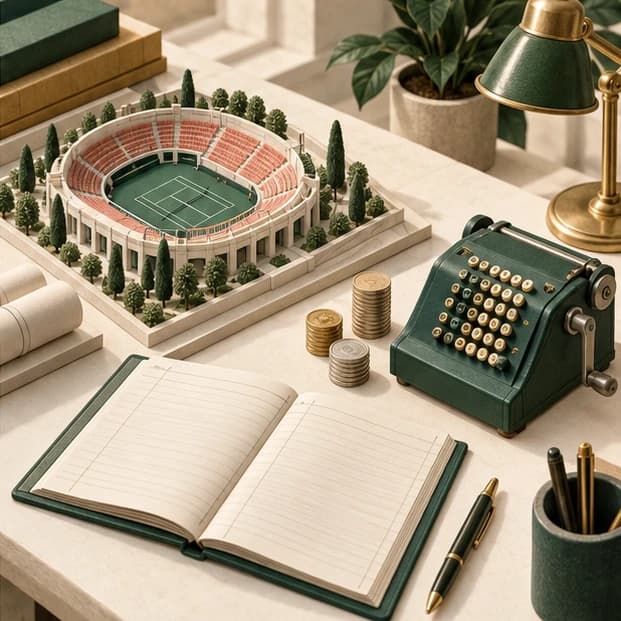
There is a valid version of your argument: a pricing policy that improves durable net cash generation can support economic value. Lower wear and replacement spending can help if those savings are real. But high margins on fewer sales help only through the total cash result, not through the margin percentage alone.
The stronger claim—“keep tickets expensive and the balance sheet can value the stadium more highly”—does not follow. Under the IAS 16 cost model, carrying amount is cost less accumulated depreciation and impairment. Under the revaluation model, it is based on fair value, not ticket face value. Depreciation generally continues while an asset is idle; usage-based methods have a specific exception when there is no production. [4]
IAS 36 tests recoverability; value in use discounts expected future cash flows. Persistent weak demand can damage those expectations. It is not concealed by a high advertised price. A single quiet match, however, is not enough to diagnose impairment. [5]
These are IFRS principles, not a claim about a particular owner’s accounts. A team, promoter, stadium landlord and concession operator may be different entities. Local GAAP, leases, public ownership and the relevant asset group matter.
Present value, not book value. No terminal value, land resale, growth, or financing. Raising the sticker price changes this value only if it changes expected net cash.
Before diagnosing the stadium / 先分清你看到了什么
A season-ticket buyer can stay home; a guest can be in a lounge. A seat listed for resale may already have earned primary-sale revenue. Separate offered capacity, tickets issued, paid tickets, scanned entries and people sitting down. Reporting practices vary. [6]
The promoter may choose prices, the landlord receive fixed rent, and another firm keep food sales. Their incentives need not match the stadium’s combined economics. A high secondary-market asking price is not necessarily money the original seller can earn.
Bad forecasts, slow repricing, contractual floors, poor discovery or an oversized venue can leave money on the table. There is no theorem that a sparse stadium must be cleverly optimized. Test targeted discounts against contribution and switching, rather than rationalizing every empty seat.
One sentence to keep / 一句话记住
And ask the converse: if a genuinely additional buyer can be served cheaply without sacrificing other revenue, why are they still outside?
Evidence & further reading / 资料
The experiments are transparent toy models, not estimates for an identified stadium. The mechanisms below are sourced; the specific crowd costs, discount leakage and cash-flow inputs above are assumptions.
The standard single-price mechanism: marginal revenue differs from the ticket price because a lower price also applies to other units. Used as theory, not as a claim that every stadium is a pure monopoly.
Research on MLB, NBA and NFL attendance: ancillary sales can make low ticket prices consistent with revenue maximization. This pushes against a simple ‘fewer fans is better’ explanation.
Revenue-management framework: perishable capacity, segmentation, uncertain demand, and the need to protect season-ticket value. Historical examples are not current league policy.
Paragraphs 30–31 distinguish cost and revaluation models; 55–56 address depreciation, idle assets, expected use and physical wear. Accounting treatment depends on the applicable framework and asset.
Recoverable amount and value in use depend on recoverable benefits; value in use discounts expected future cash flows. An unsupported face price is not a valuation method.
Los Angeles Times reporting documents why paid attendance and people in the stands can differ. A historical example of the measurement issue, not evidence about your particular match.